
Rice paddy governance and reflections from Blockchain Chicken Farm
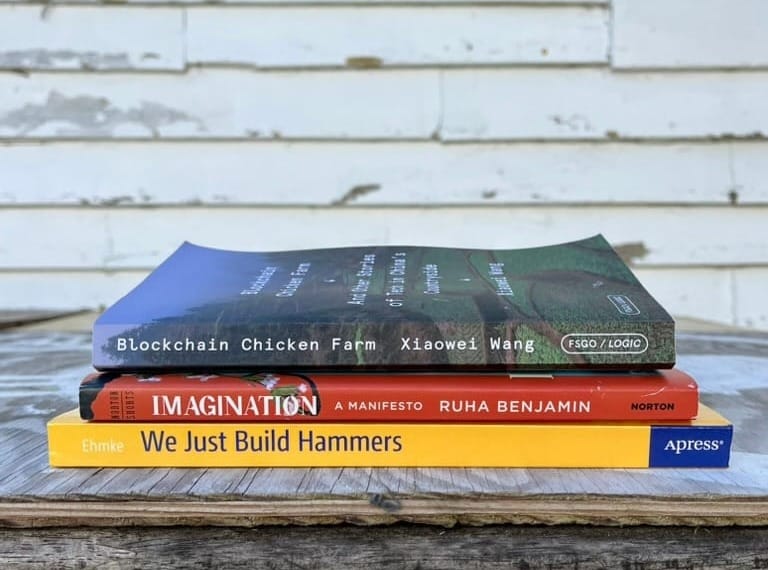
Over two evenings in October, (m)otherboard members gathered around the virtual table to discuss Xiaowei Wang's Blockchain Chicken Farm: And Other Stories of Tech in China's Countryside. Here are some highlights from our conversations.
Mara opened our first session with a striking observation that reading this book, written in 2020, feels like "receiving a letter from the future." As we gathered on the eve of major SNAP policy changes, the intersection of technology, food systems, and state power felt urgently present. As Mara reflected: "Food is the great unifier: the table is technology. This is our birthright, to break bread together."
Rice paddy governance
This book challenges one of tech culture's most sacred assumptions: Scale has become one of those things that so many people worship. If it's not scalable, it's not worthwhile. But do we want large systems where small groups benefit, or many systems where many people benefit?
The Rice Harmony Cooperative depicted in the book offers a compelling counter-example. Xiaowei describes how "the fate of one person is tied to everyone else's" through ancient irrigation systems and lottery-based paddy rotation. Every five years, farmers switch paddies randomly. No one can hoard the best plots. If you dam the water at the top of the mountain, you risk blocking water to your own paddy somewhere else. If you use pesticides, residue flows down to other families' fields.
This is governance as ongoing relationship. As Xiaowei writes, cooperative members must "resolve conflict rather than walk away from it." During covid, when urban markets disappeared, the cooperative didn't collapse—they pivoted to rice wine to meet changing demands. This adaptability emerged from their collective governance structure, not despite it.
Embodied intelligence and ancestral wisdom
The book bridges ancient practices—rice terraces, Chinese medicine, Buddhist thought, and even recipes—with contemporary technology. In the speculative recipe "How To Feed an AI," Xiaowei notes that in Chinese medicine, "there are eleven vital organs that work holistically to sustain life, and this list does not include the brain. Brain functions are scattered throughout the body."
Aiden was captivated by this reframing: "What if you actually started from a Chinese medicine perspective of understanding the body, consciousness, sentience when thinking about AI?"
Surveillance without servers
Ryan shared what struck him most: "Surveillance doesn't appear the way it's often drawn up in maximalist ways. Of course, why would you spin up another thousand servers when you can ask the auntie down the street who knows when and where everybody goes?"
This observation opened up conversations about how power operates differently across contexts—and how the US and China might be more similar than we are led to believe in popular comparisons. As Darby noted, the chilling effects of surveillance where "no one knows the consequences of critique, but no one wants to find out" feels unnervingly familiar in our current American moment.
Shanzhai culture needs shared space
A most sobering update came from Xiaowei's recent return trips to China: the Shenzhen they documented in the book no longer exists. Shanzhai culture as Xiaowei described it was an "ecosystem where there was a lot of experimentation and you were allowed to feedback, criticize, copy, make mistakes." In the wake of the pandemic Huaiqiangebei electronics market has lost its vibrancy, and focus has shifted toward industrial semiconductor investment and top-down manufacturing control.
Small pockets, long timelines
When asked about consciousness shifts and mass movements, Xiaowei invoked historian Robin D.G. Kelley's focus on those who hold onto radical dreams: "If you look at history, change comes through these different small pockets of people who come together, form coalitions, form solidarities through time and space."
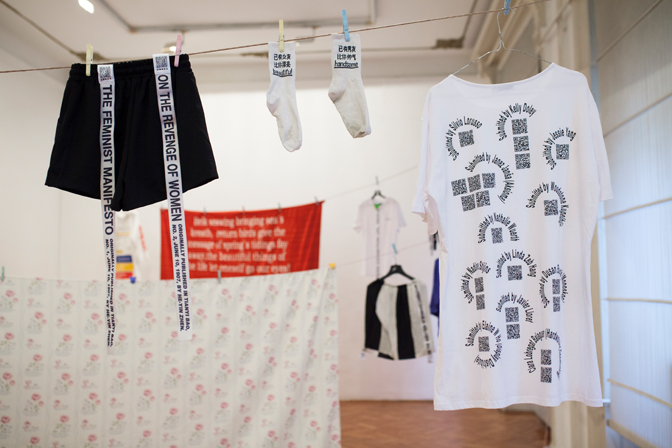
Revolutionary art also gets transmitted through time. They shared the example of artist Amy So Wu, who prints censored Chinese feminist texts onto streetwear: "You can make a new t-shirt in a day and manufacture it at crazy scale. She did Chinese feminist slogans and manifestos and turned that into the most amazing radical streetwear." Xiaowei highlighted this work as an example of hidden in plain sight resistance and revolutionary vision.
Writing softness in dystopic times
We've talked about the difficulty of writing sci-fi beyond dystopia—something that Arkady Martine has described as the limits language to describe softness rather than technical worldbuilding. Xiaowei shared the difficulty of maintaining tenderness while chronicling systems of extraction and control: "As a writer, being out in the world, I have to harden. I feel myself constantly hardening more and more. To write something that is soft, I have to be soft. It's hard to write right now."
Sara highlighted one of her favorite soft moments in the book which felt intensely familiar and intimate—old men toasting each other at a noodle shop:
"Dozens of empty bottles sit next to one table, as a group of middle-aged men slurp noodles and drink beer out of small, thin-walled plastic cups. They toast each other, they give toasts to good health. They drunkenly toast this evening, a precious sliver of time together, under the weight of their responsibilities and hardships. 'At our age, it isn't easy to find time to be with each other, and we’ve all been through a lot to be here today,' one of them says, voice slurring with emotion. I sit, eating alone. After traveling by myself for days on end, I watch with a tinge of jealousy as they relish this evening. A visceral glow of life surrounds them. In this glow, the word 'commitment' surfaces. A commitment to the path of living as life unfolds, no matter how it transforms. A desire to keep living, not against but with the specter of frailty, failure, and death. This commitment is a naked pleasure that exists under the ever-shifting, open space of change, palpable against the hungry, narrow world of optimization. It would be impossible to optimize life for these kinds of joy. Such pleasure cannot exist in a fully optimized world."
What the present demands
The book ends with these words: "The present moment promises nothing—it only demands. It demands building the communities that shift culture, that allow interbeing to thrive. It demands the work of awareness and care, instead of the tools of efficiency and scale. It demands seeing individual freedom as nothing more than a way for all of us to be oppressed. Most of all, the present demands the tender, honest work of attempting to make meaning, instead of looking, waiting, or wanting. Through the present moment I see the glimmers of liberation embedded in the work we must do at this time. Because what else can we do?"
As we closed our second session, folks shared what they were feeling: Nourished. Enlightened. Grateful. Resourceful. Stimulated. Collective. Hopeful.
Christina offered a powerful reflection: "I choose to give my energy to that which gives life. That's why I choose to be a part of (m)otherboard. What you are creating here is life, and life-giving to me. It's community. And it's subversive. Even as the world comes apart, even as neighbors are taken by ICE and we’re fighting hard to figure out where they are and supporting their families…I chose to surround myself with the environments and beings—human and beyond human—that bring us collective life and flourishing."
Continuing in community
As Xiaowei reminded us, it's about having those imaginative pockets of people to keep liberatory visions alive and continuing to exchange—talking to each other, celebrating each other's work to keep each other going, even on small scales.
Because as we learned from the rice paddies: none of us can succeed alone. Our fates are tied together. The water flows through all our fields.
Next up: We're taking November and December to rest and reflect, reconvening book club in January to discuss another text that challenges how we think about technology, community, and care. Stay tuned!
Resources and links
- I Deliver Parcels in Beijing - translation of viral courier gig economy memoir
- A Memory Called Empire by Arkady Martine - hopeful sci-fi
- Monk & Robot by Becky Chambers - Ryan's hopeful sci-fi rec
- Buddha graphic novel series by Osamu Tezuka (creator of Astro Boy) - Xiaowei's current cozy re-read
- Collective Action School - organizing school for tech workers
- Global Circuits Recording - speaker series featuring Maurice Carney and Mark Po-Jen Hsu on tech supply chains from Congo to Taiwan
- Governance Futures - exploring new models for collective action and "greenhouses" for collaboration
– The God(m)others